safe and
productive lives
and enterprises
Adrian Keogh - Case Study
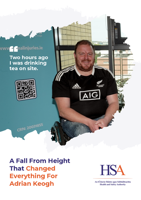
“Two Hours Ago, I Was Drinking Tea on Site”
A fall from height that changed everything for Adrian Keogh
In 2014, Adrian Keogh captained the Kiltegan Senior hurlers, leading them to a Leinster League victory against Mountmellick of Laois. A year later, he was still the same energetic man – working hard on sites, cycling, hill walking and throwing himself into sport.
“I was full of life, enjoying life,”
he recalls.
On 20 July 2015, everything changed. While working as a groundworker on a busy
construction site in Dublin, the ground gave way beneath him. A concrete pillar – a Kelly block – crashed down, pinning him to the earth when he fell into an excavation that collapsed.
“It happened so quickly. One second I was standing there, the next I was being buried alive. I could hear the clay falling and the water rising underneath me, and I honestly thought my eyes were going to burst from the pressure.”
Trapped, he thought he would never see his family again.
“I told my mate Bob: tell my parents to look after my daughter, tell my partner I love her. I’ll see her in the next life. Bob was crying, saying, you can tell her yourself. But in my head, I was going. I thought I was gone.”
A war zone in the operating theatre
Emergency crews rushed Adrian to hospital. In the operating theatre, he realised just how suddenly life had changed.
“It was like something out of a war film. The chaos, then the sudden silence. And I thought: two hours ago, I was drinking a cup of tea on site. Now I’m lying here, not knowing if I’ll ever walk again.”
Doctors told him he had serious spinal and nerve damage. The next day came the devastating words: “
You’re paralysed.”
Adrian was only 30.
“You go into denial. You say to yourself, no, that’s not me. But it is.”
The hidden battles in hospital
The physical toll was severe. Adrian had broken ribs, a punctured lung, a fractured spine, and a pelvis shattered on both sides. Infections set in, requiring repeated washouts and months on IV antibiotics.
“I had a serious infection in my spine – pus running down my back. They had to leave it open with a pipe and drain it every few hours. I used to wake up freezing, with blankets and heaters trying to warm me.”
The pain was relentless.
“I was screaming during x-rays. I had to tell visitors to leave because the roars were horrendous. I lost so much weight my collarbone was sticking out. It was like being in a washing machine – you didn’t know where you were going or what was next.”
Facing himself for the first time
After months in hospital, Adrian was finally discharged. Returning home was another shock.
“In the hospital you’re in another world, but when you get home, it hits you. I saw myself in the mirror for the first time in the wheelchair and thought: that’s not me. I don’t recognise that person. It’s very hard to accept.”
Daily routines most people take for granted became challenges.
“Things like getting into a shower, going to the toilet, or just walking to the car. People give out about not having hot water – but when you need a chair just to get washed, you see life differently.”
The bravery of asking for help
The mental recovery was just as tough. Adrian admits the turning point was learning to seek support.
“The hardest thing I ever had to say was: I need help. People think you have to be macho and keep it all in – but that’s not bravery. It’s braver to say you need help. It wouldn’t be fair to myself not to get counselling. That would be an injustice.”
Counselling, he says, made all the difference.
“There’s no judgement. It’s just someone to listen, and half your problems are gone. A problem shared is a problem halved. I still go for counselling today, and it’s the best thing I ever did.”
For Adrian, self-care isn’t selfish – it is survival.
A message for every worker
Adrian’s story is a stark reminder of how quickly life can change.
“One minute is all it takes. You could be having a cup of tea at 10 o’clock, and by 12 o’clock your whole life is changed.
If something doesn’t feel safe, stop. Speak up. Don’t think ‘it’ll be grand.’ Because it won’t. And it’s not the lads in the office who’ll suffer – it’ll be you, and your family, and your life outside of work.
For one minute of thinking, one minute of safety – life is more than work.”
About this interview
This case study was captured as part of a podcast conversation between Joan Flynn, Senior Inspector at the Health and Safety Authority, and Adrian Keogh. It forms part of the HSA: Work at Height podcast series, which shares real stories of how falls at height change lives in an instant.
“Speaking to Adrian is a stark reminder to all people working in the construction industry that accidents can change your life forever. Adrian’s life has changed dramatically and he has suffered tremendously after an avoidable accident at work. Adrian speaks about taking a minute to assess the job, if you don’t feel like it’s safe to proceed, you need to stop. Don’t take chances. Falls from height are preventable.”
said Joan Flynn, Senior Inspector at the Health and Safety Authority
Related File