

HSA Quarry Inspection Campaign Targets Lung Disease Risk
Monday, 21 September
The Health and Safety Authority (HSA), in partnership with the Irish Concrete Federation (ICF), has today launched a nationwide inspection campaign aimed at tackling one of the most serious long-term health risks facing quarry workers: exposure to quarry dust. Prolonged exposure to fine respirable dust particles can penetrate deep into the lungs and may lead to serious lung diseases.
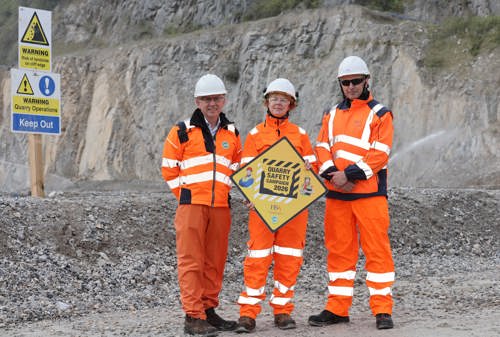
The campaign, which will run from 21 September for two weeks, will involve HSA inspectors from the Occupational Health division visiting quarrying operations across the country to assess dust control measures and risk assessments.
Quarry dust can be generated by activities including drilling, blasting, crushing, screening, transportation and maintenance. The HSA is reminding operators to identify where exposure to inhalable dust can occur, use effective measures to contain and suppress dust at source, and minimise workers’ exposure. Operators should consider all activities and areas on site, including maintenance, housekeeping and welfare facilities.
Key areas inspectors will focus on include the following:
- Rock composition and quarry activities generating inhalable dusts
- Dust risk assessments, potential employee exposures and control measures
- Sources of respirable crystalline silica
- Controls for respirable crystalline silica dust where relevant
- Water suppression and dust extraction systems
- Machinery and site maintenance activities
- Vehicle cab filtration and maintenance arrangements
- Housekeeping and welfare facilities
- Training and worker awareness regarding dust health risks and controls
- Evidence that dust control measures are being regularly reviewed and maintained
Programme Manager with the Health and Safety Authority, Darren Arkins, said,
"The health effects associated with long-term dust exposure can be severe, life-changing and entirely preventable. Through this inspection campaign, the Authority aims to ensure that quarry operators are identifying sources of inhalable dusts, particularly respirable crystalline silica if relevant, implementing effective control measures and monitoring the measures to minimise worker exposures and protect health over the long term."
"Respirable crystalline silica can cause irreversible lung disease and increase the risk of lung cancer. The finest dust particles are often invisible, but the damage they can cause is very real. Employers need to ensure regular and ongoing review of their control measures",
he added.
Gerry Farrell, Chief Executive of the Irish Concrete Federation, said,
"Protecting workers from occupational health risks is a priority for the quarrying and concrete products sector. Effective dust control is not only a legal requirement but an essential investment in the long-term health of workers."
He added,
"The Irish Concrete Federation strongly supports this campaign and encourages all quarry operators to review their dust management arrangements, making sure they are effective, and that they engage with workers on the importance of controlling exposure to dust."
The HSA is urging quarry operators to review their dust control measures, ensuring that dust-generating activities are managed through effective engineering controls, water suppression, extraction systems, good housekeeping and worker training.
Further information and practical guidance on controlling dust in quarrying operations is available on the HSA website.