safe and
productive lives
and enterprises
Psychosocial Hazards & Remote Working
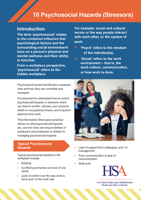
Psychosocial hazards are factors in the design or management of work that have the potential to cause harm to a person’s psychological wellbeing. Harm to psychological wellbeing means harm to mental health and changes in subsequent behaviour. Psychosocial hazards increase the risk of work-related stress (WRS) and can have other psychological or physical consequences.
In the standard ‘on-site workplace’, examples of psychosocial hazards include conflict, bullying, high demands, low control, role confusion, low support, and improper communication (e.g., shouting, not communicating at all, or mumbling). Exposure to one or more of these hazards on an on-going basis can cause harm. This is why early intervention and communication of issues is crucial.
There are specific and non-specific factors which aggravate occupational safety and health (OSH) psychosocial risks in remote work settings. These can differ in many ways to those which apply to ‘on-site working’. More information related to the OSH psychosocial risks associated with ‘on-site working’ can be found here: Psychosocial Hazards Information Sheet.
In the remote setting, there are factors that aggravate OSH psychosocial risks which are separate to those which apply generally. Psychosocial risks associated with remote working are the result, firstly, of the different direct circumstances or systems of work which prevail at the remote work site (e.g., domestic setting or remote working hub). They are also the result of indirect circumstances – the social and psychological environmental factors pertaining. There is a third issue related to lack of familiarity with risk prevention and management systems in place where the workforce is mainly working off site.
For any risk assessment, the physical and psychosocial circumstances must be assessed as well as the access to, and the availability of supports and controls, training, management, professional development and acknowledgement of dignity and respect at work. This must be done in all work situations and locations (e.g., on site and remote working).
Related Files